
Omega-3 dosage calculator
The only free calculator that adjusts for what you actually absorb — and projects your Omega-3 Index over time, the blood measure researchers use, without the blood test.
Not every milligram on the label reaches you
How much omega-3 you absorb depends on the oil's chemical form and whether you take it with fat (Davidson 2012; Schuchardt & Hahn 2013; Dyerberg 2010). That's why the calculator asks how you take your supplement — and why it may recommend a different number of softgels than the label math alone.
- Ethyl-ester oils can lose around half their omega-3s when taken without food
- Triglyceride and phospholipid (krill) forms are far less meal-sensitive
- The calculator sizes your dose to the delivered amount, not the label
The Omega-3 Index, explained
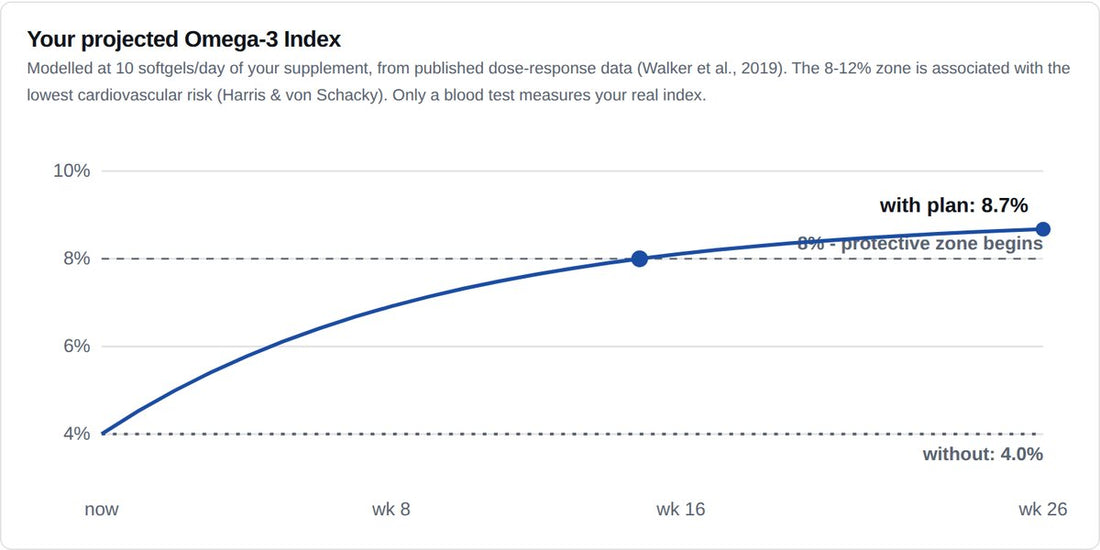
The Omega-3 Index is the share of EPA and DHA in your red blood cell membranes — the measure the research community uses, with 8–12% associated with the lowest cardiovascular risk (Harris & von Schacky). The calculator charts your projected trajectory toward it, week by week.
- A typical Western diet sits near 4–5% (Stark 2016)
- Levels build over 3–4 months of consistent intake (Walker 2019)
- The projection is a model — only a dried-blood-spot test measures your real index

Targets from published guidance, not marketing
Every range in the calculator traces to a public reference — EFSA, WHO, ISSFAL and the American Heart Association — with the full citation list below. If your diet already covers your target, the tool tells you a supplement is optional.
- Adult baseline of 250–500 mg/day from EFSA and WHO reference intakes
- Goal ranges follow the research — heart, cognition, mood, training, triglycerides
- Your weekly fish meals are subtracted first (USDA composition data)
- Plans never exceed the FDA's 3,000 mg/day supplemental ceiling
The references behind the numbers
EFSA — Scientific Opinion on Dietary Reference Values for fats: 250 mg EPA+DHA adequate intake for adults; +100–200 mg DHA in pregnancy and lactation.
FAO/WHO — Fats and Fatty Acids in Human Nutrition: adult and age-banded EPA+DHA intake ranges.
ISSFAL — International Society for the Study of Fatty Acids and Lipids: minimum 500 mg/day EPA+DHA for cardiovascular health; ≥200 mg/day DHA in pregnancy.
American Heart Association — Scientific advisories on omega-3 fatty acids and cardiovascular disease, including ~1 g/day EPA+DHA for patients with coronary heart disease and 2–4 g/day for triglyceride lowering under medical supervision.
Harris & von Schacky — The Omega-3 Index as a risk factor for coronary heart disease (Preventive Medicine): the 8–12% target zone.
Walker et al., 2019 — Predicting the effects of supplemental EPA and DHA on the Omega-3 Index (American Journal of Clinical Nutrition): the dose-response model behind the projection.
Stark et al., 2016 — Global survey of the Omega-3 Index: typical Western baseline levels.
Davidson 2012; Schuchardt & Hahn 2013; Dyerberg et al. 2010 — Bioavailability of omega-3 fatty acid formulations: the effect of ester form and dietary fat on absorption.
US FDA — Guidance that supplemental EPA+DHA intake should not exceed 3 g/day, within 5 g/day from all sources considered safe.
USDA FoodData Central — EPA and DHA composition values used for the fish-meal estimates.
Common questions
How much omega-3 should I take per day?
For general health, the widely accepted adult target is 250–500 mg of combined EPA and DHA per day. Specific goals studied in research use more — 500–1,000 mg for heart support, up to 2,000 mg in mood research, and 2,000–4,000 mg for triglyceride management under medical supervision. The calculator above personalises this against your diet.
What's the difference between EPA and DHA?
They are the two key long-chain omega-3s. DHA is the structural one — concentrated in the brain and retina. EPA is the signalling one — more prominent in mood and inflammatory-balance research. Most people want both; specific goals may justify tilting the ratio.
Can you take too much omega-3?
Yes. The FDA advises keeping supplemental EPA+DHA at or below 3 g per day (5 g from all sources). Very high doses can affect blood clotting — which is also why anyone on blood-thinning medication should involve their physician before supplementing.
Do I need a supplement if I already eat fish?
Maybe not — two to three oily fish meals a week covers the general-health target for most adults, and the calculator will tell you if yours does. Supplements exist for the weeks the fish doesn't happen, and for targets above the baseline.
Why does my 1,000 mg fish oil only contain 300 mg of omega-3?
The number on the front is usually the total oil, not the active omega-3s. Flip to the supplement facts panel and add EPA + DHA together — that is the number that matters, and the one this calculator asks for.
Meet AstaKrill
Whatever the calculator says you need, the supplement that covers it should publish its numbers. Ours does.
- Omega-3s in phospholipid form, with astaxanthin and choline
- EPA+DHA content disclosed on the label — plug it straight into the calculator
- Third-party tested every batch, 30-day guarantee